Episode 68 · Engineering Deep Dives
LNG Liquefaction: How Natural Gas Becomes a Cryogenic Cargo
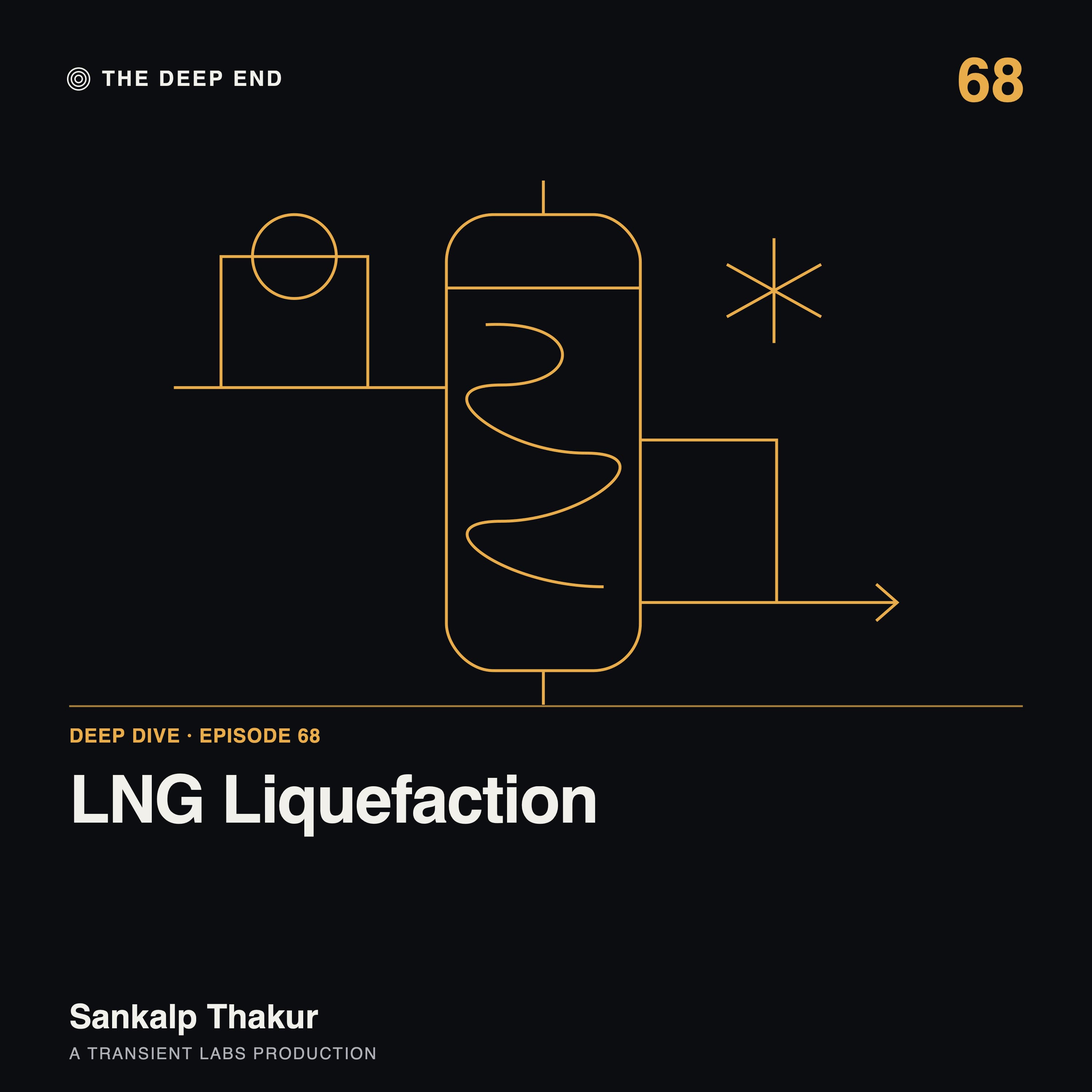
A warm main cryogenic exchanger sends fictional engineer Leila Okonkwo through an LNG liquefaction train. Explore feed pretreatment, cascade and mixed-refrigerant cycles, temperature glide, coil-wound and plate-fin exchangers, expansion and end-flash. Boil-off gas, storage, specific power, cryogenic materials, rollover and rapid phase transition connect the cold box to a cargo ready for ocean shipping. Story characters, facilities and story figures are fictional and illustrative.
Listen to the show on your preferred podcast platform.
Listen on Spotify ↗Listen on Apple Podcasts ↗Listen on Pocket Casts ↗Listen on Podcast Addict ↗Listen on Castbox ↗Listen on TuneIn ↗
See it work
Explore the working principle
Inside this episode
- Cold open: the exchanger that ran warm
- Why liquefy: six hundred to one
- Pretreatment: what must never freeze or attack aluminum
- Cascade, C3MR, DMR and AP-X
- Mixed refrigerants and temperature glide
- The main cryogenic heat exchanger
- JT valves, expanders and end-flash
- Storage, ships and boil-off gas
- Specific power, train capacity and ambient penalty
- Materials that survive minus one hundred sixty two
- Safety: rollover, RPT and exclusion
- Troubleshooting payoff: the lean weekend top-up
- Closing: what the cold box teaches
Production credits & AI disclosure
Scripts generated with Claude Opus. Synthetic narration generated with Edge TTS. Reviewed, listened to, and approved by Sankalp Thakur.